
The Volume-Weighted Average Price (VWAP) is more than a technical indicator—it’s a cornerstone of institutional execution strategy, liquidity assessment, and intraday market structure analysis. This article explores VWAP from a professional trader’s lens, detailing its calculation, strategic applications, and integration into algorithmic execution frameworks.
Introduction: VWAP as an Execution Benchmark
VWAP represents the average price of a security weighted by traded volume over a defined period, typically intraday. Unlike simple moving averages, VWAP incorporates both price and liquidity, making it a preferred benchmark for institutions aiming to minimize market impact and slippage. It’s especially relevant for:
Buy-side execution desks benchmarking trade quality
Sell-side algorithms optimizing order slicing
Quantitative traders modeling intraday price behavior
VWAP Calculation Methodology
VWAP is calculated cumulatively throughout the trading session:
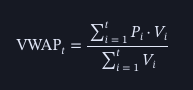
Where:
PiP_i = price at time interval ii
ViV_i = volume at time interval ii
This formula ensures that high-volume trades exert more influence on the average price, aligning with real liquidity dynamics.
VWAP vs Price Action: Institutional Interpretation
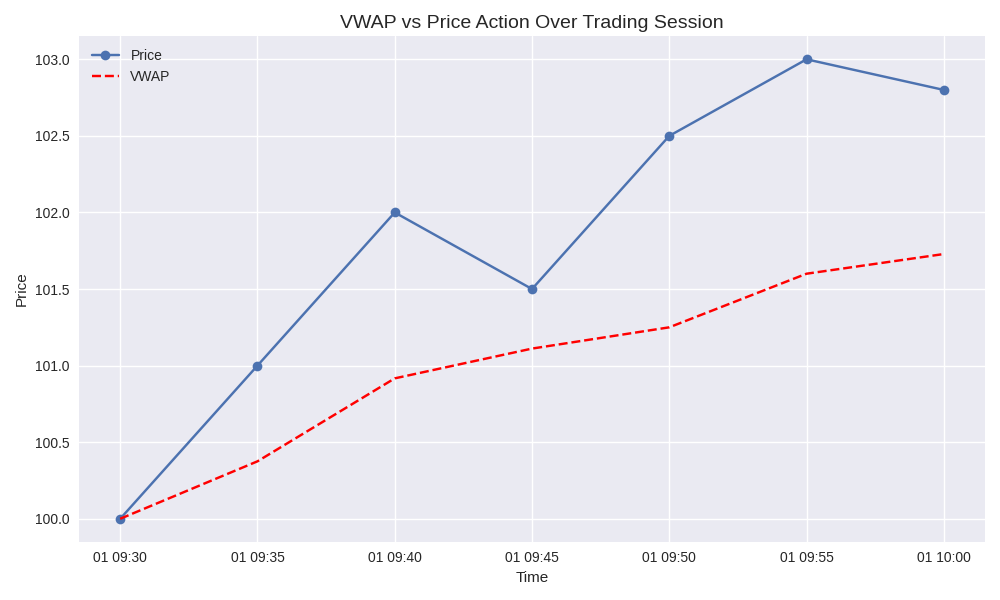
The graph below illustrates VWAP versus price action over a simulated trading session. Institutional traders interpret deviations from VWAP as signals of liquidity imbalance or momentum:
Price > VWAP: bullish sentiment or aggressive buying
Price < VWAP: bearish sentiment or aggressive selling
Mean reversion to VWAP: common in passive execution strategies
Click/open the card above to download the graph.
Institutional Use Cases
1. Execution Quality Benchmarking
VWAP is used to evaluate whether trades were executed at favorable prices relative to market liquidity. For example:
A buy order executed below VWAP is considered efficient.
VWAP slippage metrics are tracked across brokers and algorithms.
2. Liquidity-Sensitive Order Slicing
Algorithms like TWAP, POV, and VWAP-based execution engines use VWAP as a reference to:
Minimize market impact
Avoid adverse selection
Align with liquidity curves
3. Intraday Mean Reversion Models
Quant desks use VWAP as a dynamic anchor for:
Identifying overbought/oversold conditions
Structuring statistical arbitrage trades
Enhancing signal-to-noise ratio in high-frequency strategies
VWAP in Algorithmic Execution
VWAP is embedded in smart order routers and execution algorithms:
Static VWAP: targets execution near the day’s VWAP
Dynamic VWAP: adjusts participation rate based on real-time volume
Arrival Price + VWAP hybrid: balances immediacy with price improvement
Advanced implementations integrate:
Real-time volume forecasting
Microstructure-aware slicing (e.g., avoiding auction spikes)
Adaptive logic based on slippage and fill rates
Limitations and Considerations
Not predictive: VWAP is descriptive, not forward-looking
Volume distortion: Large block trades can skew VWAP
Latency sensitivity: Real-time VWAP requires low-latency data feeds
Session dependency: VWAP resets daily; not suitable for multi-day analysis
Conclusion
For institutional traders, VWAP is not just a line on a chart—it’s a tactical benchmark, a liquidity compass, and a foundation for execution analytics. Whether embedded in algorithms or used for post-trade analysis, VWAP remains indispensable in navigating the fragmented, high-speed landscape of modern markets.